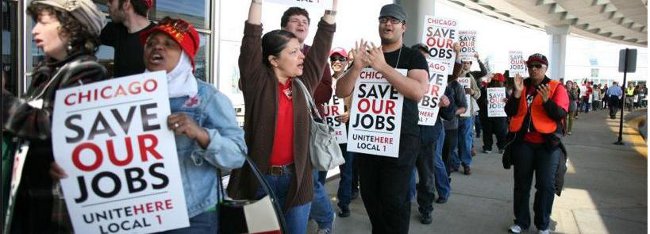
Hundreds of workers protest at Chicago O’Hare Airport
Airport workers frustrated over lack of response by city officials for job protections

As the city gets closer to signing new deals that will jeopardize over 1,500 Chicago jobs, hundreds of airport concessions workers and allies held an action at the Chicago O’Hare Terminal 1 departures area on Thursday, May 10, calling for city officials to move forward on measures that would improve the quality and stability of airport jobs. Actions on Thursday come in the wake of recent firings at the airport and more than two years of asking city officials to put in place job protections and a living wage for airport workers.

Much of the food and retail concessions at both O’Hare and Midway Airports are set to undergo a redevelopment overhaul in the coming months, a transition process that will affect over 1,500 workers and over $200 million in annual revenues. Redevelopment at other major U.S. airports, such as JFK in New York and Cleveland Hopkins International in Ohio, has been accompanied by labor harmony and worker protection procedures to ensure a smooth transition to new concessions operations. Chicago has, thus far, failed to implement such measures.

“I’m proud of the customer service I provide to Chicago travelers,” said Maria Iniguez-Villalobos, a food server at O’Hare. “But, I depend on my job. If I lose my job, how am I going to put food on the table? How will I help pay for my kids’ college?”

Earlier this year, Chicago’s airport concessions transition process was put to the test as operations at O’Hare Terminal 5 were taken over by new companies. This transition resulted in more than half of the existing retail concessions workforce losing their jobs. Now, as upcoming transitions threaten the careers of hundreds of Chicagoans, many of them are feeling the pressure.

“There’s too much at stake for us to let this process move forward without a thoughtful worker transition,” said Henry Tamarin, President of UNITE HERE Local 1. “Airport workers need to know their jobs are secure. If they got it done at airports in Cleveland, New York, Los Angeles and so many other cities, then I know it can be done here in Chicago.”
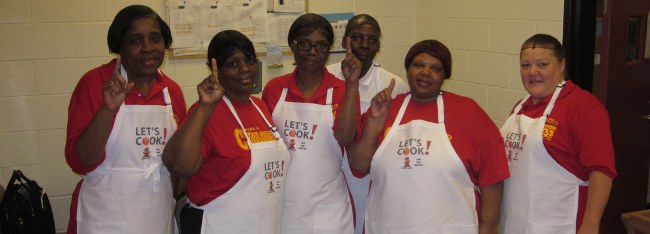
Chicago Public Schools agrees with lunch workers, moves toward fresh food!

Over the past four months, Chicago’s lunchroom workers have spoken with parents across the city about their vision for the food served to Chicago’s schoolchildren. The workers, members of UNITE HERE Local 1, also took their vision for freshly cooked food to the bargaining table. Today, in a landmark agreement, the workers and the Chicago Board of Education signed a new union contract that begins to ensure Chicago’s kids will eat fresh food for years to come.

In addition to important improvements in wages, protecting health care and job security, the contract begins to change the food model in Chicago’s schools by halting any expansion of “frozen food” schools.

The lunchroom workers’ “Let’s Cook” campaign, part of Real Foods Real Jobs, had drawn particular attention to the increasing use of frozen, pre-plated meals in the schools. Now, with the exception of one school, the Board of Education has committed to stop transitioning schools from cooking to “warming” kitchens. This victory ensures many Chicago children avoid a future school diet of reheated frozen food and highlights the positive changes possible when frontline workers and administrators collaborate.

“This is a great victory because our voice was heard. We have not only stopped the expansion of frozen food in our schools but also maintained our benefits and our jobs,” said Constance Hatchett, a 12-year CPS lunchroom cook from Hope Academy.

As part of this agreement, CPS will actively solicit and incorporate input from lunchroom workers. A “Good Food Committee,” with representatives from both the Board of Education and frontline workers, will meet monthly to identify best practices regarding healthy food. A bi-annual survey of lunchroom workers will also be conducted to ensure worker input on menu or program changes in schools.

“We’re proud that the lunchroom workers brought the issue of palatable, freshly prepared food to the table,” said Henry Tamarin, President of UNITE HERE Local 1. “It’s a fair settlement but we still have some work to do with the Board of Education. There are still some students in the system subjected to pre-packaged, frozen food every day from the time they start kindergarten to the time they leave 8th grade. All students deserve freshly prepared food.”

The 5-year agreement covers more than 3,200 lunchroom workers who prepare and serve over 77,000 breakfasts and 280,000 lunches every day in over 600 schools. Lunchroom workers ratified the contract on April 28 and look forward to further efforts to ensure Chicago’s kids are fed the food they deserve.

Hundreds picket Hyatt HQ, protesting threats to cancel healthcare

Thousands could lose coverage under Hyatt’s proposal; Clergy denounce Hyatt’s “harsh tactics”
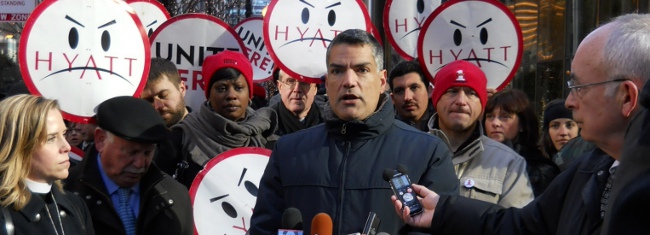
Hundreds of hotel workers and allies are picketing at Hyatt’s global headquarters today in protest of Hyatt’s proposal to strip health insurance from Chicago hotel workers and their families after more than two years of contract negotiations. Bargaining between Hyatt and the members of UNITE HERE Local 1 hit a turning point in late November after Hyatt threatened to cut off health benefits unless workers give up their fight and abandon their boycotts. Now hotel workers, religious leaders, and health advocates are calling on the company to withdraw its threat to Chicago workers. If Hyatt refuses, thousands of workers and members of their families in Chicago could lose health insurance at the end of February.

“If they take our health insurance away, my kids will suffer,” says Jacqueline Smith, who has worked in the housekeeping department of the Hyatt McCormick Place for the last 10 years and is a single mother of five children—thre e with special needs. “I have heart problems and high blood pressure. If I don’t get my medication or they take away my breathing machine, then I can’t support my family.”
On November 21, 2011, Hyatt negotiators first officially informed the Union of their intent to cut health benefits, with an insurance cut-off going into effect on December 31, 2011. On November 29, Hyatt officials informed the Union that they would postpone the cut-off date by 60 days, extending coverage until the end of February.

In the last two years of contract negotiations, Hyatt has refused to budge on crucial demands to curb subcontracting and ease working conditions for housekeepers—demands met by Hilton and other hotel employers citywide. In response, Hyatt workers have held several limited-duration strikes and called for boycotts of their hotels. Over $20 million in group bookings have pulled out from boycotted Hyatt hotels nationwide.

“According to Jewish tradition, preventing the healing of the sick is akin to shedding blood,” says Rabbi Brant Rosen of the Jewish Reconstructionist Congregation in Evanston, IL, who is participating in today’s protests. “It is truly a shandeh that Hyatt would stoop to these unacceptably harsh tactics as a negotiating ploy.”

This is not the first instance of Hyatt’s labor controversies. In July, Hyatt turned heat lamps on striking workers at the Park Hyatt Chicago during a brutal heat wave. In Boston, Hyatt fired its entire housekeeping staff at three non-union hotels, replacing women who had worked at Hyatt for decades with temporary workers earning minimum wage.

UNITE HERE Local 1 and Local 450 represent approximately 1,500 workers at the Hyatt Regency Chicago, Park Hyatt, Hyatt McCormick Place, and Hyatt Regency O’Hare. Contracts for area Hyatt workers expired on August 31, 2009. Since then, area Hyatt workers have carried out several limited duration strikes and other demonstrations, including a weeklong strike in September 2011.

Hyatt threatens to cut off workers’ healthcare

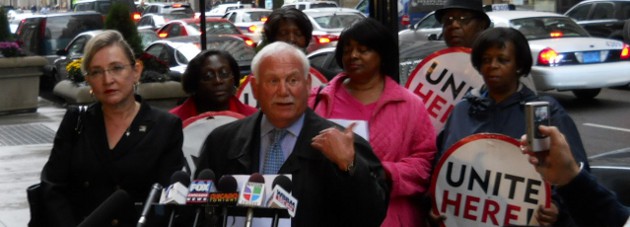
After more than two years of bargaining, contract negotiations between Hyatt Hotels and members of UNITE HERE Local 1 hit a crisis point last Monday when Hyatt threatened to cut off health benefits unless workers give up their fight and abandon their boycotts. In response, hotel workers, religious leaders, and health advocates are holding a press conference in front of Hyatt Hotels’ global headquarters to denounce Hyatt for forcing workers to choose between their families’ immediate medical needs and a fight for their long-term survival.

“My son has suffered from chronic ear problems ever since he was a baby and is scheduled to go into surgery this month. Now Hyatt is asking me to decide between my son’s health and a future where I could lose my job,” says Cristian Toro, who has worked as a banquet server at the Hyatt McCormick Place for eight years.

On November 21, 2011, Hyatt negotiators first officially informed the Union of their intent to cut health benefits, with an insurance cut-off going into effect on December 31, 2011. On Tuesday evening, November 29, Hyatt officials informed the Union that they would postpone the cut-off date by 60 days, extending coverage until the end of February.

In the last two years of contract negotiations, Hyatt has refused to budge on crucial demands to curb subcontracting and ease working conditions for housekeepers—demands met by Hilton and other hotel employers citywide. In response, Hyatt workers have held several limited-duration strikes and called for boycotts of their hotels. Over $20 million in group bookings have pulled out from boycotted Hyatt hotels nationwide.

This is not the first instance of Hyatt’s labor controversies. In July, Hyatt turned heat lamps on striking workers at the Park Hyatt Chicago during a brutal heat wave. In Boston, Hyatt fired its entire housekeeping staff at three non-union hotels, replacing women who had worked at Hyatt for decades with temporary workers earning minimum wage.

“It’s obscene to use the right to healthcare as a bargaining point,” says Dr. Quentin Young, a healthcare advocate who was once the personal physician of Dr. Martin Luther King, Jr. “In this economy, to throw healthcare costs on workers on top of everything else is unfair. As a doctor I call on all medical professionals to honor the Hyatt boycotts.”

UNITE HERE Local 1 and Local 450 represent approximately 1,500 workers at the Hyatt Regency Chicago, Park Hyatt, Hyatt McCormick Place, and Hyatt Regency O’Hare. Contracts for area Hyatt workers expired on August 31, 2009. Since then, area Hyatt workers have carried out several limited duration strikes and other demonstrations, including a weeklong strike in September 2011.

UNITE HERE Local 1 joins other CPS staff and service unions to issue statement of support for teachers

In recent weeks, the Board of Education has waged a fierce attack in the media on teachers represented by CTU Local 1 in the Chicago Public School system, focused primarily on the length of the school day.

Now-in a show of support for CPS teachers-Local 1 and other unions representing thousands of service and support staff at CPS are calling for an end to the Board’s confrontational rhetoric. In a press conference today, these unions released a statement, encouraging instead a more respectful dialogue and collaboration with staff who work directly with our city’s children to achieve improvements in the quality of education in Chicago Public Schools.

Unions participating who released a statement represent thousands of service and support staff at the school, such as custodians, lunchroom workers, aides, security guards and engineers, who will also face separate contract negotiations with the Board of Education in coming months. UNITE HERE Local 1 President Henry Tamarin and Local 1 member Linda Green, a lunchroom worker at Chicago Public Schools, both spoke at the press conference.

Local 1 was one of 5 unions that signed on to the following statement to the
Board of Education:
“We represent the employees of Chicago Public Schools who are not teachers. We are the Aides, Security Guards, Custodians, Engineers, Lunchroom Workers and all the other workers who are responsible for Chicago’s children from the moment they step on to the school grounds in the morning until they leave at the end of the day.

We are professionals who make sure that the school buildings work, are clean, that our children our safe and that they are fed. When it comes to Chicago’s kids, we are where the rubber meets road.

We’re proud of the work we do and think that the children of Chicago are serious business and should be treated in that fashion. We ask that the Board of Education take a more constructive and serious approach with us on addressing our mutual issues.

The Administration thus far has chosen to engage in a media campaign against the teachers, rather than thoughtful negotiations, to the detriment of the entire community. We are all in this together, and are all in this for the children that we are here to support. There has yet to be a proposal from the administration across the bargaining table for a longer school day – we first read about it in the newspaper rather than hearing about it from the administrations’ negotiators.

We didn’t create the length of the school day, the Board of Education did. We’re willing to negotiate extending the school day, but this takes good faith negotiations, not more Board of Education press statements and confrontational rhetoric and tactics. Our children deserve a more respectful and thoughtful approach.”

Chicago Hyatt Workers Join Nationwide Strikes

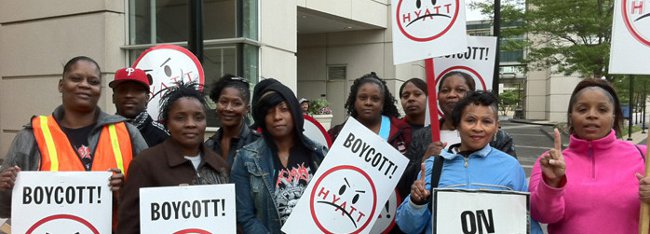
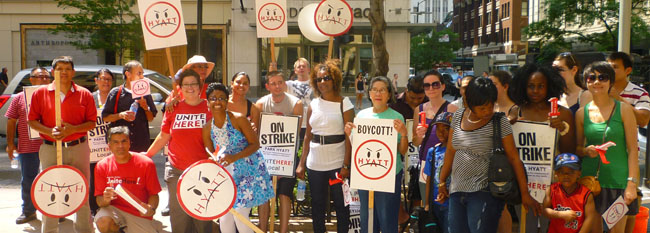
In an emblematic fight over the direction of our economy, today Hyatt workers in Chicago join thousands of Hyatt hotel workers in launching week-long strikes in cities nationwide, including Los Angeles, San Francisco, and Honolulu. Workers from the Hyatt Regency Chicago and the Hyatt McCormick are participating in local strikes. By striking, workers are standing up for decent jobs for themselves and their families, but they are also fighting for the right to take a stand against an abusive employer that is destroying good jobs in their North American hotels.

Hyatt has singled itself out as the worst employer in the hotel industry. Hyatt has replaced career housekeepers with minimum wage temporary workers and imposed dangerous workloads on those housekeepers who remain. In July, Hyatt turned heat lamps on striking workers at the Park Hyatt Chicago during a brutal heat wave. In Boston, Hyatt fired its entire housekeeping staff at three non-union hotels, replacing women who had worked at Hyatt for decades with temporary workers earning minimum wage.

Most notably, Hyatt has sparked controversy for its abuse of housekeepers. Injury rates for Hyatt housekeepers are high, and academic studies have shown that housekeeping can lead to debilitating injuries. Housekeepers at some Hyatts clean as many as 30 rooms a day, nearly double what is typically required at union hotels. To date, OSHA or its state counterparts have issued 15 citations against the Hyatt at ten hotels and 3 citations against two of the Hyatt’s housekeeping subcontractors at two of those hotels, alleging violations of safety regulations that protect housekeepers and other employees. The agencies have proposed fines totaling $95,405.00 between Hyatt and its subcontractor.

“Two years ago, the Hyatt Regency renovated the hotel and brought in larger, heavier beds. It makes my job much more difficult. I can’t lift the mattress because my left arm feels like it’s coming out of the socket,” says Angela Martinez, a housekeeper at the Hyatt Regency with 23 years of service. “We are hard-working women, not machines. I’m on strike because I want the right to stand up to Hyatt wherever it is abusing housekeepers.”

Hyatt workers have called for boycotts at 17 Hyatt properties and have led dozens of public demonstrations all across North America. Already, Hyatt has lost over $20 million in hotel business.

“Hyatt is one of the most abusive hotels in their treatment of housekeepers and has the worst record on subcontracting,” says Henry Tamarin, the President of UNITE HERE Local 1. “They refuse to budge on these important issues, and workers want the right to take on Hyatt wherever these abuses occur.”

UNITE HERE Local 1 represents approximately 1000 workers at the Hyatt Regency and the Hyatt McCormick Place. Contracts for area Hyatt workers expired on August 31, 2009. This week of Hyatt strikes follows other work stoppages at Hyatt properties in Chicago, including a strike at the Park Hyatt on July 21, 2011, a strike at the Hyatt Regency on June 20, 2011, and a one-day strike at the Hyatt Regency in Rosemont in September 20101. In May 2010, Hyatt Regency workers—led by more than 100 housekeepers—walked off the job, protesting worsening working conditions in housekeeping after a major hotel renovation.

Workers in each striking city have reached agreements with other major hotel employers, like Hilton and Starwood. This week’s strike affects approximately 3,000 unionized hotel workers at six hotel properties across North America, including the largest Hyatt property in the world—the Hyatt Regency Chicago.

Breaking News! Charges filed against Hyatt for turning heat lamps on striking workers during heat wave

Hotel workers are filing charges with the government against Hyatt for turning heat lamps on striking workers at the Park Hyatt Chicago during a brutal heat wave that swept the region last Thursday, July 21. After nearly two year of contract negotiations, hotel workers went on strike in protest of Hyatt’s abuse of housekeepers and the company’s ability to outsource jobs.

Ten heat lamps in the awning above the Park Hyatt front entrance were turned on striking workers when the strike began Thursday morning and were left on for about an hour. Heat lamps were turned off shortly after reports about them surfaced in the press. That day, an excessive heat warning was issued by the National Weather Service, with heat index readings climbing above 100 degrees in downtown Chicago. Hyatt released a public statement the following day, admitting that a manager was responsible for turning heat lamps on striking workers.

Charges filed with the National Labor Relations Board (NLRB) by UNITE HERE Local 1, the union representing housekeepers, dishwashers, bellmen and other hotel workers at the Park Hyatt Chicago, contend, “The employer assaulted the employees and tried to fry them by shining heat lamps on them in the middle of what was already a hot, humid day.”

“They put the heat lamps on us, like we were nothing,” said Linda Long, a cook at the Park Hyatt. “If the heat didn’t kill us, the heat lamps would.”

Nationwide, Chicago-based Hyatt has stirred controversy for its abuse of housekeepers and for replacing long-term employees with workers from temporary agencies at far lower rates of pay. In Boston, Hyatt fired its entire housekeeping staff at three non-union hotels, replacing women who had worked at Hyatt for decades with temporary workers at far lower rates of pay. Housekeepers at some Hyatts clean as many as 30 rooms a day, nearly double what is typically required at union hotels. In Chicago, workers say Hyatt has not adequately addressed their concerns about housekeeping workload and subcontracting at the negotiating table.

“Many of my coworkers are getting hurt—hurting their wrists or backs lifting heavy mattresses or slipping on wet floors—and Hyatt is ignoring our pain,” says Ofelia Martinez, a housekeeper at the Park Hyatt. “Turning the heat lamps on us is just another example of how Hyatt abuses us.”

Academic studies have shown housekeeping to be dangerous work that can lead to debilitating injuries. In a study published in the American Journal of Industrial Medicine examining a total of 50 hotel properties from 5 different hotel companies, Hyatt housekeepers had the highest injury rate of all housekeepers studied by hotel company.