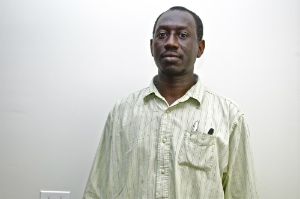
 In 2003, I came to the United States as a refugee because I feared for my safety in my home country Sudan. Leaving home was hard because I was going to a country that I didn’t know. But, the hardest part was leaving my mother behind. I didn’t know if I was ever going to see her again.
I will sum up the civil war that is going on in Sudan: the country is divided into two, the North and the South. The regions are divided into tribes and the government has favoritism over certain tribes. If they don’t like you because you are from a certain tribe they will arrest you or kill you for reasons that they say are “correct.” I suffered through these injustices and so did my family. In Sudan, everyone’s lives are at risk – even children.
In 2000, I escaped the war and moved to Egypt. In Egypt, I worked two jobs as a construction worker and in a supermarket. During my time there I learned how to register for asylum through the United Nations. By applying for political asylum it allowed me to live in another country that was not my own and have protection from the war in Sudan. Applying for asylum was not easy because it was a lengthy process. I had to go through several interviews and background checks. It took a while, but I was granted asylum to the United States.
I am very grateful that through the asylum program I got a lot of help from the US government. They helped with my travels, they found me a roommate, and they helped me get my first job at a cleaning company. However, my biggest barrier was the language. At first people didn’t really understand me and that was frustrating. But, I took classes to improve my speaking and with time it has gotten better.
In 2008, I became a US citizen. As a US citizen, I have protection from the US government to go back to Sudan and not get arrested. So in 2009, I visited my family. I was very happy to see my brothers, sisters, and mother. I got married and had to leave my wife for a year in Sudan. That was one of the hardest years of my life because I didn’t know if I would be able to bring her to the United States. Luckily, in 2010 I was able obtain a visa for her.
Currently, I am the only one that is supporting my family financially and this has been thanks to my union job. I have been working at the Ritz-Carlton Hotel since 2004 as a banquet houseman. I had never had a union job before. In Sudan, the corrupt government controlled the unions. I wasn’t scared that my union job at the Ritz would be controlled by the government here in the US, but when I first started working I didn’t understand what it meant to be part of a union until I started attending meetings and actions.
Having a union has given me a voice at work. I feel protected from not losing my job, and I can stand up for my rights if they are being violated. This would never be possible back at home, and I am proud that my union taught me how to be a leader. As a leader in the union, I make sure that I help my coworkers know where they can resolve their problems, and I teach them how to stand up for their rights at work. No one should be mistreated at work.
No matter how busy I get I make time for my kids and wife. I recently had a baby boy and have a two year-old girl. They are being raised in a different environment than I did where they are safe. I’m proud that they will be able to go to college, something I could never do. I don’t know if my kids will ever get to go to Sudan but that will be their decision. I just hope that one day my mother can meet them.
Abdelhalim Albadr: Living Free
I will sum up the civil war that is going on in Sudan: the country is divided into two, the North and the South. The regions are divided into tribes and the government has favoritism over certain tribes. If they don’t like you because you are from a certain tribe they will arrest you or kill you for reasons that they say are “correct.” I suffered through these injustices and so did my family. In Sudan, everyone’s lives are at risk – even children.
In 2000, I escaped the war and moved to Egypt. In Egypt, I worked two jobs as a construction worker and in a supermarket. During my time there I learned how to register for asylum through the United Nations. By applying for political asylum it allowed me to live in another country that was not my own and have protection from the war in Sudan. Applying for asylum was not easy because it was a lengthy process. I had to go through several interviews and background checks. It took a while, but I was granted asylum to the United States.
I am very grateful that through the asylum program I got a lot of help from the US government. They helped with my travels, they found me a roommate, and they helped me get my first job at a cleaning company. However, my biggest barrier was the language. At first people didn’t really understand me and that was frustrating. But, I took classes to improve my speaking and with time it has gotten better.
In 2008, I became a US citizen. As a US citizen, I have protection from the US government to go back to Sudan and not get arrested. So in 2009, I visited my family. I was very happy to see my brothers, sisters, and mother. I got married and had to leave my wife for a year in Sudan. That was one of the hardest years of my life because I didn’t know if I would be able to bring her to the United States. Luckily, in 2010 I was able obtain a visa for her.
Currently, I am the only one that is supporting my family financially and this has been thanks to my union job. I have been working at the Ritz-Carlton Hotel since 2004 as a banquet houseman. I had never had a union job before. In Sudan, the corrupt government controlled the unions. I wasn’t scared that my union job at the Ritz would be controlled by the government here in the US, but when I first started working I didn’t understand what it meant to be part of a union until I started attending meetings and actions.
Having a union has given me a voice at work. I feel protected from not losing my job, and I can stand up for my rights if they are being violated. This would never be possible back at home, and I am proud that my union taught me how to be a leader. As a leader in the union, I make sure that I help my coworkers know where they can resolve their problems, and I teach them how to stand up for their rights at work. No one should be mistreated at work.
No matter how busy I get I make time for my kids and wife. I recently had a baby boy and have a two year-old girl. They are being raised in a different environment than I did where they are safe. I’m proud that they will be able to go to college, something I could never do. I don’t know if my kids will ever get to go to Sudan but that will be their decision. I just hope that one day my mother can meet them.
First contract settled for Waldorf-Astoria workers
On September 6, hotel workers at one of Chicago’s top-rated hotels, the Waldorf-Astoria, ratified their first contract covering 130 workers.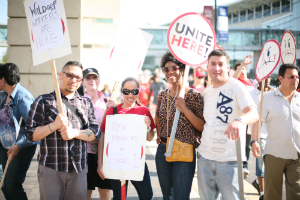
Last fall, workers unionized joining UNITE HERE Local 1 in an effort to improve safety conditions for housekeepers and wages and benefits for hotel workers. Highlights of the contract brought workers up to the citywide hotel standard which improves job security and provides economic increases over the next four years. Additionally, the new contract improves safety for housekeepers, dropping room quotas. An overwhelming majority of workers ratified the new contract.
Wyndham Grand Chicago Riverfront At-Risk of Labor Dispute
The Wyndham Grand Chicago Riverfront (formerly the Hotel 71) has been downgraded on www.unionhotelguide.org to “At-Risk of Dispute” due to its contract expiration on 8/31/2013. Unlike Hilton, Starwood, and Hyatt union properties in Chicago, the Wyndham Grand Chicago Riverfront has not guaranteed its workers or guests labor peace past the end of last month.
Customers of the Wyndham Grand Chicago Riverfront are encouraged to insist on the strongest possible contract language that indemnifies groups for meeting cancellations caused by labor disputes. Please stay tuned on this rapidly developing situation.
Dayton calls for review of Wayzata Investment Partners’ labor policies
Gov. Mark Dayton on Wednesday called for a review of the state’s investment in Wayzata Investment Partners after the company’s labor practices at an Indiana casino it owns were criticized by union officials. Wayzata Investment is a major stockholder in the Star Tribune.
VIDEO: Double Down 9-3-13
Majestic Star Casino employees are locked in a battle over wages during its pending bankruptcy. Chuck Coppola reports.
Labor Day Rally at Majestic Star Casino
Casinos like the Majestic Star were approved by political leaders based on the promise they would bring stable jobs to hard-hit areas like Northwest Indiana. Workers at the Majestic Star receive low-cost, high quality healthcare, which is free for individuals and only $30 a month for families. Workers haven’t had raises since 2011.
“We just want decent wages and to keep our benefits intact for our families,” said Jeri Elliot, Majestic Star housekeeper for 13 years. “Unions built this region, and we’re going to continue to fight to make this region stronger.”
Hundreds of casino workers from Ameristar and Blue Chip casinos, and Chicago hotel workers, lunchroom workers and airport workers who are members of UNITE HERE Local 1 joined Majestic Star workers to stand together to keep the middle class intact in Northwest Indiana.
Check out the photos from our rally here.
Majestic Star Casino employees protest, call for fair contracts
Gary — Majestic Star Casino employees and their supporters donned red shirts and waved signs outside the casino entrance on Labor Day in a protest calling for a fair contract for workers.